
Find People Across Clayton Records
A useful Clayton search starts with the detail already known. A full name can lead to a voter match, a property owner, a deed party, a court case, a business filing, or an obituary. An old address calls for a different route. Johnston County property records can identify the parcel and owner, while maps, deeds, permits, and historical sources show how that address changed. A death date or relative’s name points toward the obituary index, cemetery database, vital-record index, or an estate file.
Keep the town and county boundaries in view. Smithfield is the Johnston County seat and holds the main deed, court, tax, election, and vital-record offices. A Clayton postal address can sit outside town limits or within the extraterritorial jurisdiction, known as the ETJ. County records therefore remain vital even when the mail says Clayton.
- Search the strongest name index and record the spelling, middle initial, date, and unique ID.
- Check the Johnston property roll for owner, mailing address, parcel number, and physical address.
- Follow the deed book and page or search the party name in the land-record index.
- Compare court, obituary, burial, business, or voter records for an independent match.
- Contact the correct custodian when an index omits the image, full file, or older material.
This order keeps a Clayton search focused.
One result is a lead, not identity proof. Common names, older spellings, and different people who share an address make a second source essential.
Clayton People Search Offices
Clayton’s Town Clerk keeps municipal files, but the county offices in Smithfield hold many of the records that connect people with land, cases, and family events. The Register of Deeds indexes land instruments and Johnston vital events. The Clerk of Superior Court holds court, estate, and special-proceeding files. Town Hall is the route for Clayton meeting records, permits, development files, and other municipal material. Detailed access rules and request steps belong with the Clayton public records system.
Johnston Register of Deeds
207 E Johnston Street, Suite 209
Smithfield, NC 27577
919-989-5160
Johnston Clerk of Court
207 E Johnston Street
Smithfield, NC 27577
See courthouse directory
Use the Town desk for municipal records and the Smithfield offices for county-held files. Sending a request to the wrong government does not transfer custody of the record.
Search Clayton Property Owners
The Johnston County property card is the best first stop when an address or owner name is known. Basic Search begins with a required choice among Property Owner Name, Parcel Number, and Property Address. A result may show the owner, mailing and physical addresses, parcel or NCPIN, tax ID, legal description, acreage, values, and deed reference. The situs address means the parcel’s physical location. It can differ from the mailing address used for the tax bill.
Open the Johnston property owner search before reviewing its captured search screen.
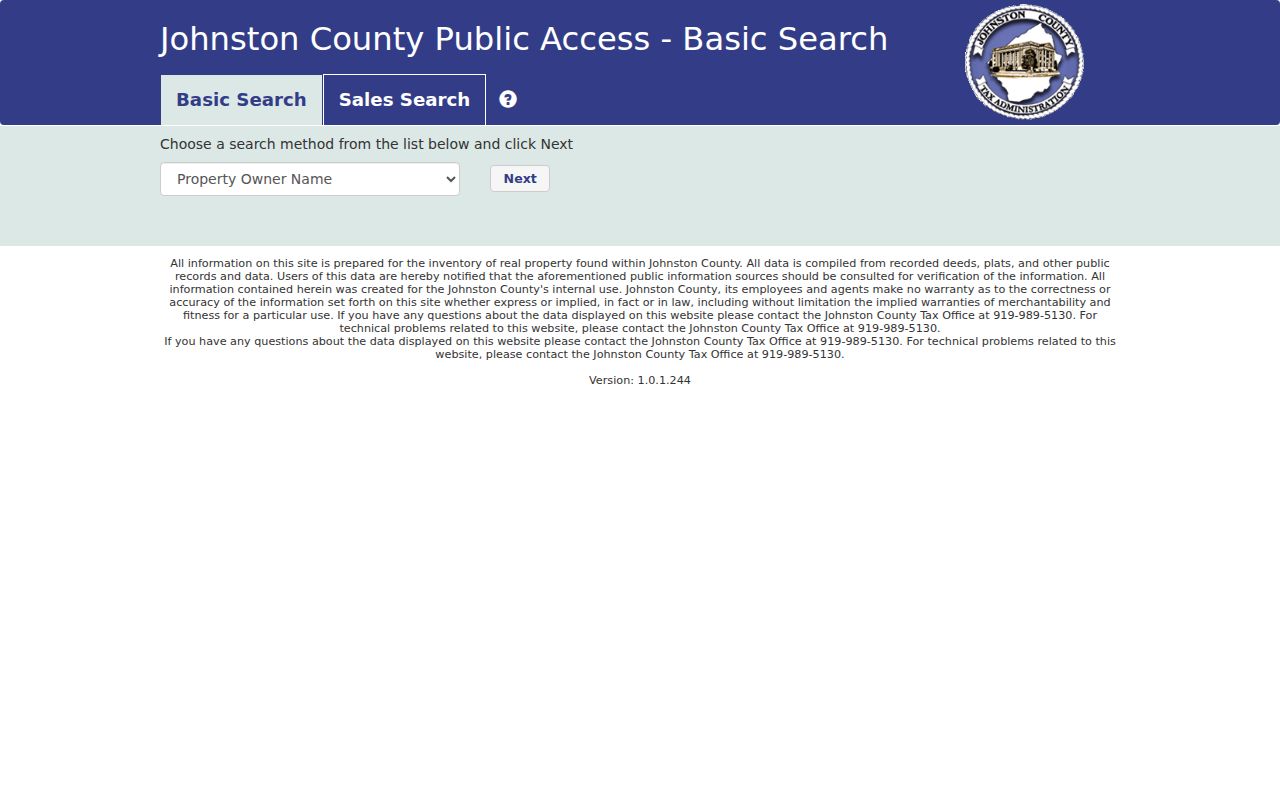
The selector keeps name, parcel, and address searches separate, which helps prevent a broad query from mixing unrelated properties.
| Known detail | Start here | Save from the result |
|---|---|---|
| Owner name | Property Owner Name | Indexed owner, mailing address, every parcel |
| Street address | Property Address | Situs, parcel ID, owner, deed link |
| Parcel or NCPIN | Parcel Number | Legal description, values, linked map |
MapClick then confirms parcel shape, adjoining land, aerial context, and jurisdiction. The recorded deed remains the authority for ownership.
Clayton Deed Index Search
EagleWeb gives public users a name-based route into Johnston land records and images. Search by grantor, the person giving an interest, or grantee, the person receiving it. Other controls include document type, reception number, recording dates, subdivision, block, and lot. A basic asterisk wildcard catches name endings. Advanced mode uses a plus sign to require a word and a minus sign to exclude one.
- Index
- A searchable list that points to a recorded item; it may not show every fact in the image.
- Grantor and grantee
- The indexed parties who transfer and receive an interest in a land instrument.
- Book and page
- A durable citation used to retrieve a recorded document.
- Parcel or NCPIN
- A county identifier that joins tax, map, and deed evidence more safely than a street label.
Search spelling variants because the county recommends checking every possible form of a proper name. The portal supplies land images, while vital-record searches do not provide certificate images. The county is still indexing older instruments and does not publish a first complete online year. Older deed microfilm at the Heritage Center reaches 1759.
Trace Clayton Court Records
Clayton has no separate municipal court. Johnston County District and Superior Courts hear local matters, and the Clerk in Smithfield keeps the files. The statewide eCourts Portal supports anonymous party-name, case-number, hearing, and judgment searches. Smart Search can show a case caption, party roles, filing date, events, dispositions, hearings, and financial entries that are public. It is a docket, which is the court’s running case record, not a promise that every pleading or exhibit is online.
| Record trail | What it covers | Best access channel |
|---|---|---|
| District Court | Lower-level criminal, traffic, domestic, and lower-dollar civil matters | eCourts, courthouse terminal, Clerk file |
| Superior Court | Felonies and higher civil matters | eCourts, courthouse terminal, Clerk file |
| Estates | Probate, representatives, heirs, and filed wills | eCourts where public, Estates Division |
| Federal court | Eastern District of North Carolina cases | PACER and the federal clerk |
Public terminals add searches by defendant, case number, victim, or witness. Ask the Clerk for the full or certified file. Juvenile, adoption, sealed, and expunged matters are not ordinary public records, and protected identifiers can be redacted.
Clayton Vital Records Paths
Johnston County Register of Deeds issues county birth, death, and marriage certificates. NC Vital Records covers statewide birth, death, marriage, and divorce products. A public vital index and a certified certificate are different. The county portal permits searches of vital records without images, while North Carolina law limits certified copies to eligible people and their authorized representatives under G.S. 130A-93.
A county certified birth, death, or marriage copy costs $10; an uncertified copy costs $0.10. Mail requests need the subject’s details, relationship, identification, payment, and a stamped return envelope. Divorce research begins with the Johnston court file because a state divorce certificate is only a summary. The state route is useful for events outside Johnston County or certificate types available only at state level.
Historical research follows a broader path. Heritage Center holdings include marriage bonds, registers, newspapers, church records, and county microfilm. Those sources can establish family facts, but they do not replace a certified legal copy.
Clayton Burial Search Details
Clayton’s official CemSites database covers City Cemetery, Forest Hills, and Maplewood. It is more detailed than a basic name list. Searchers can filter by cemetery and military service, including veteran status, rank, branch, and war service. A result may provide first, middle, last, and Hebrew names, birth and death dates, interment date, grave type and location, a map pin, a variant name, and a memorial link.
Use the Clayton burial search to see the live cemetery and service filters.
The captured interface shows why this record set can separate two people with the same surname through dates, cemetery placement, and service information.
Recent and upcoming interments also appear in the system. When a plot detail is unclear, Town staff can arrange an on-site appointment. Cemetery data can confirm placement and dates, while an obituary or death record supplies a different type of evidence.
Search Clayton Obituaries Since 1801
The Johnston County Heritage Center obituary index reaches from 1801 to the present. Search by a partial name, as many as four keywords, age at death, publication-date range, or record ID. The Smithfield Herald supplies most entries since 1885, with earlier material from papers such as the Raleigh Register, Farmers & Mechanic, and Clayton Bud. Selected Clayton News-Star obituaries appear from 2008 forward.
Open the Johnston obituary index before reviewing the captured fields.
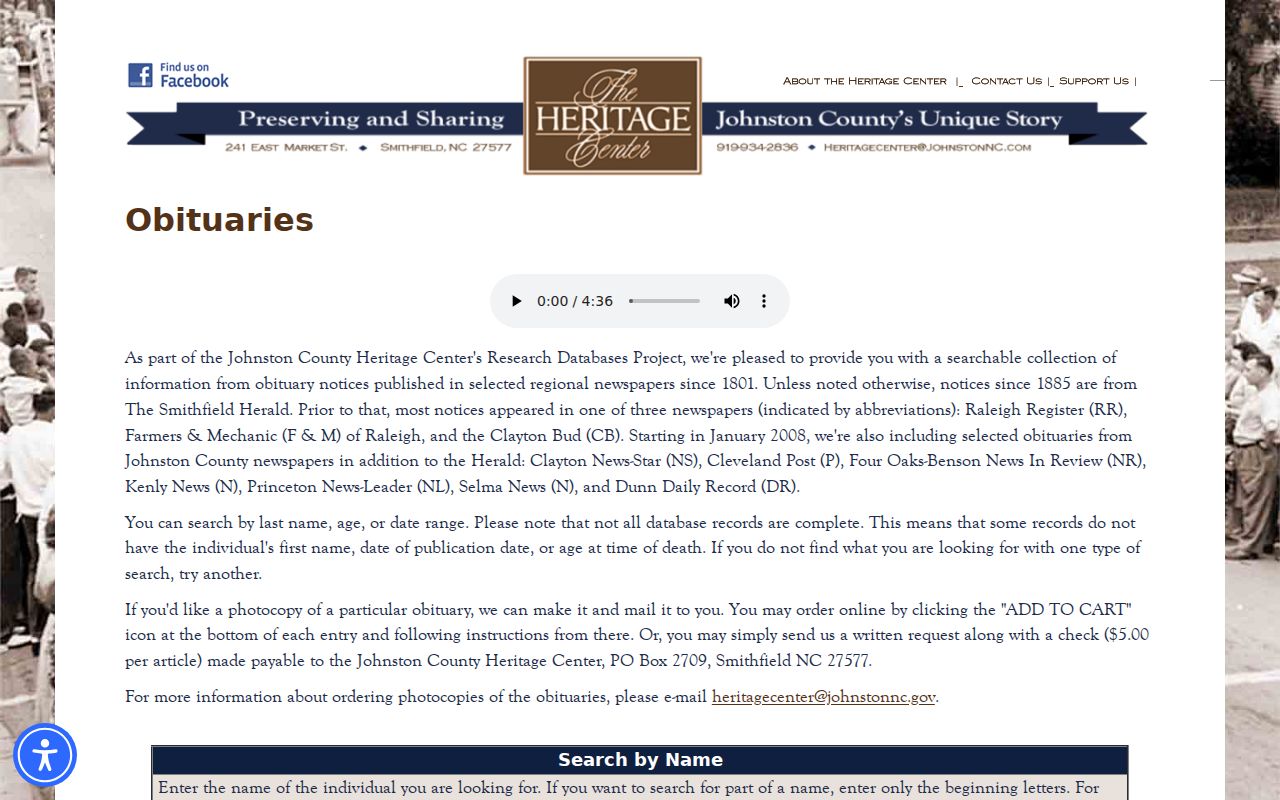
The name, keyword, age, date, and ID controls help test relatives, churches, roads, and other details when the first name or date is missing.
Search surname-only forms, initials, married and prior surnames, and spelling variants. An article copy costs $5. An obituary can reveal relationships and places, but it is not a certified death record.
Reconnect Through Clayton History Records
Hocutt-Ellington Memorial Library and the Heritage Center form the main historical fallback. Most Hocutt-Ellington local-history material is held in climate-controlled offsite storage, so contact the library before visiting. In-house access includes Ancestry Library, while cardholders can use HeritageQuest and the NC LIVE Newspapers.com North Carolina collection. DigitalNC and Sanborn maps add school, newspaper, and address context.
See the Clayton local-history access notes before reviewing the library capture.
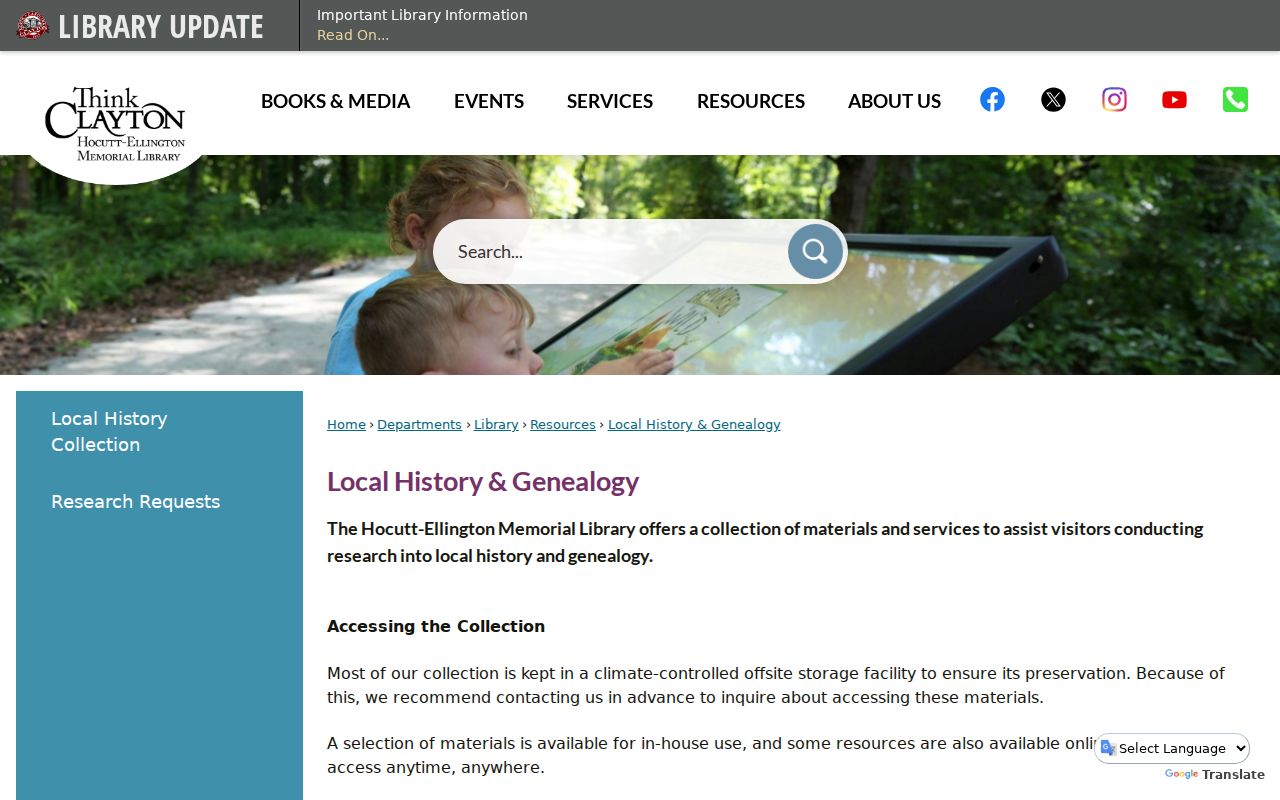
The offsite warning matters because advance notice can turn an empty shelf visit into a prepared research appointment.
Heritage holdings include about 2,500 books, 800 microfilm reels, 100,000 photographs, and 600 private collections. County yearbooks run from the 1920s to the present in the holdings, and census databases cover 1850 through 1940. No official shelf list confirms exact Clayton city, reverse, or telephone directory years, so those dates should be requested rather than guessed.
Clayton Permit Search Is Changing
Permits can connect a service address with a permit number and work type. Clayton’s legacy eSuite accepts any one of three fields: permit type, permit number, or service address. When an address fails to populate, it can mean no permit exists or that the site falls outside Town jurisdiction. That makes MapClick and the municipal boundary just as important as the permit result.
Review the legacy Clayton permit search and its address control.
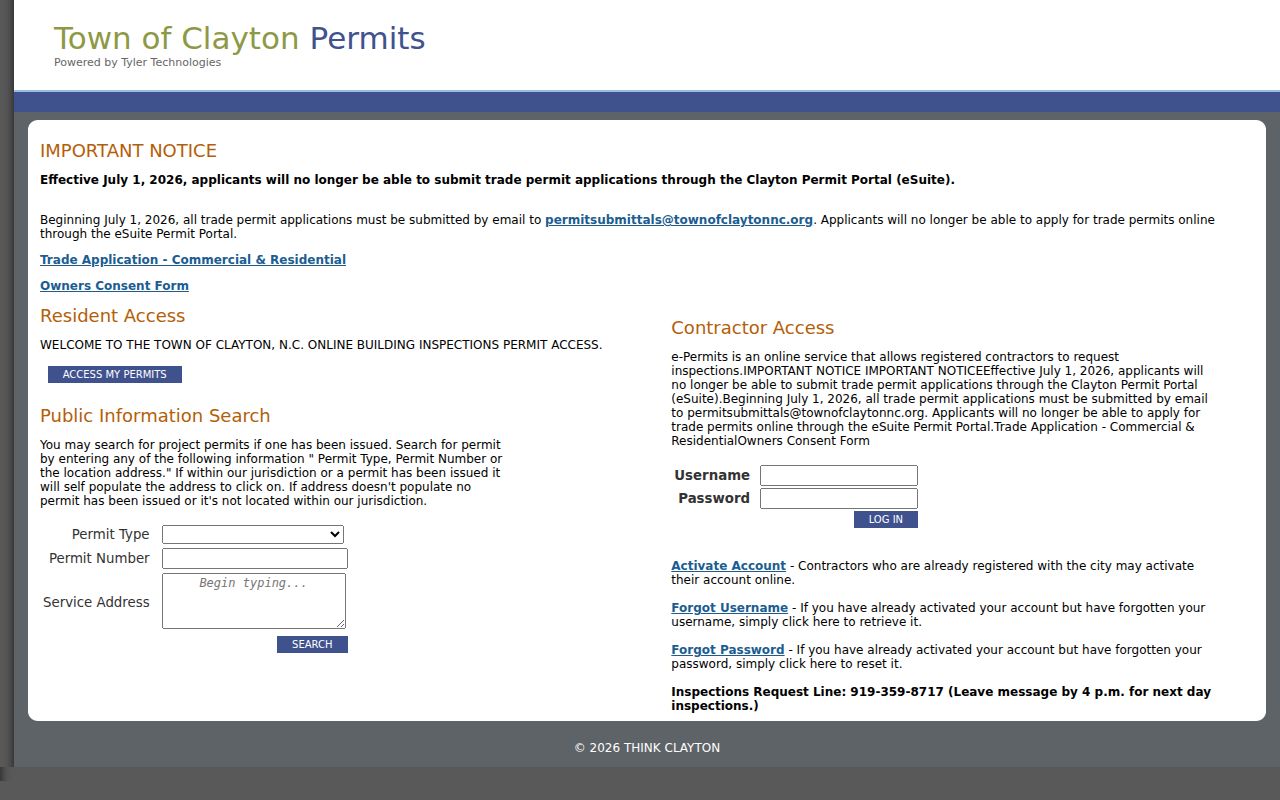
The capture preserves the older entry point that may still matter for records created before the platform change.
Permit Clayton Phase I launched in July 2026 and opened access to more than 20 selected record types across Planning, Engineering, and Inspections. The new system handles applications, status, payments, inspections, comments, and notices. Transition-era research may require both systems. For a defined address and date range with no browsable result, the Town’s records request portal is the fallback.
Find Clayton Business Connections
A business name can lead to a person through several official records. Start with the North Carolina Secretary of State entity search for status, formation, registered agent, offices, officials, annual reports, and filing images. Search exact and variant names and save the SOS ID. A registered agent is the legal service contact, not proof of ownership or Clayton residence.
Then check an assumed business name in the Johnston Register of Deeds index. The Clayton permit trail may tie the operation to a service address, while the property card identifies the parcel owner. A board-specific license search can confirm a regulated credential and public status. North Carolina does not offer one complete umbrella search for all professions, so identify the correct licensing board first.
The same distinction applies to directories. An official filing shows the role stated in that record. It does not establish every person involved in the operation.
Clayton Custody and Safety Lookups
The Johnston Active Inmate Search is a current county-jail snapshot. It can list a name, primary charge, and arrest date. The NC Department of Adult Correction covers state prison and community-correction history from 1972, not every county booking. Federal custody uses the Bureau of Prisons locator. Always return to the Clerk for the court disposition because an arrest is not a conviction.
The North Carolina offender registry supports name and geographic searches.
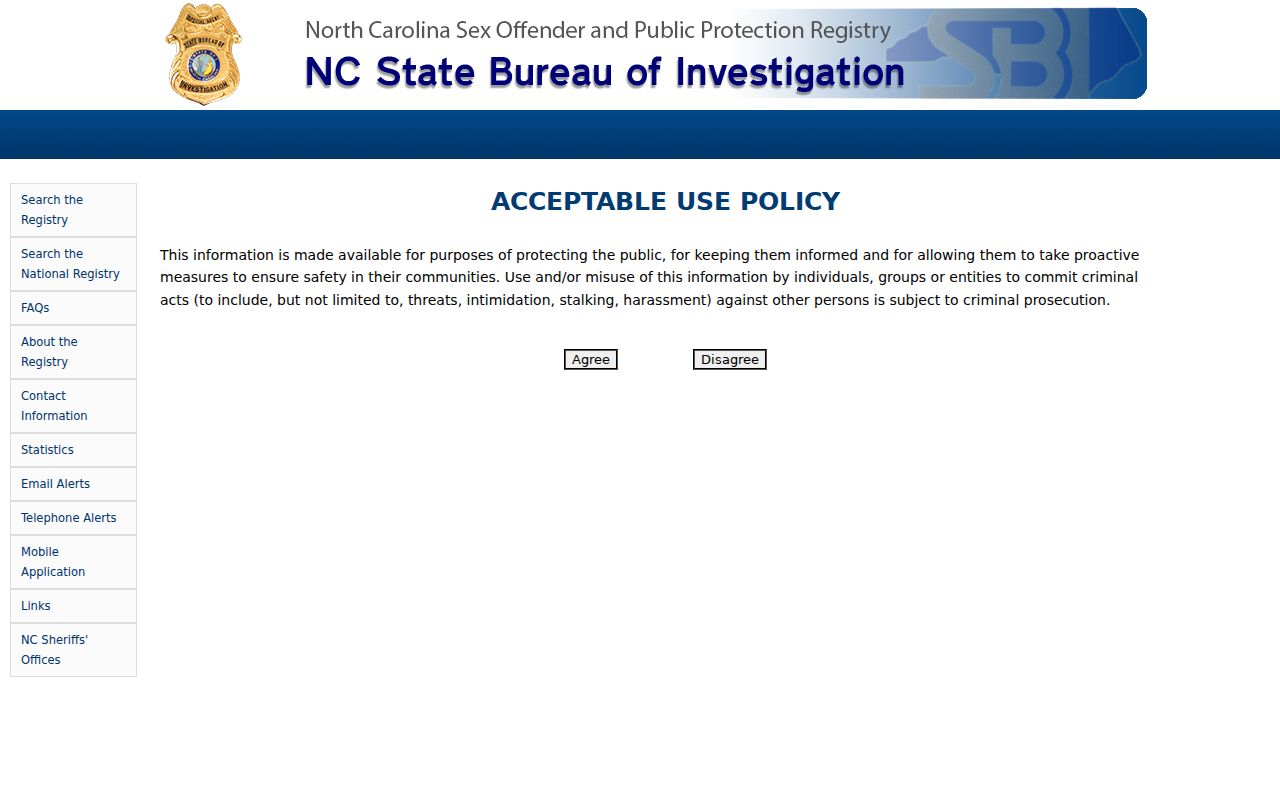
The captured official registry emphasizes a public-safety search, with details that still require current verification.
Lawful personal use. Public data never grants permission to threaten, follow, monitor, or harass a person. Verify safety information with the responsible agency.
Clayton Voter Search Boundaries
The state voter lookup can match a Clayton-area voter by first and last name, with optional middle initial, birth year, county, and status controls. Selecting Johnston County helps with common names. A match may show public identity, registration status, addresses unless protected, age rather than exact birth date, party, precinct and districts, registration date, and election participation.
Participation history records whether a person took part and the voting method. It never reveals candidate choices or ballot selections. Protected identifiers include exact birth date, Social Security data, driver-license number, registration-agency identity, election email, and voter-ID material. Address protection may apply through North Carolina’s Address Confidentiality Program.
Clayton-area precinct names do not prove that an address is incorporated. Compare the municipal district and current boundary before drawing a town-status conclusion. The full field and file rules appear with the Clayton voter registration lookup.
Search Clayton Unclaimed Property
Unclaimed property offers a free statewide name trail when accounts or other property have been transferred to the North Carolina Treasurer. It can help reconnect a name with an owner record without paying a private locator merely to reveal that the state holds something. Search the person’s name and likely variants, then follow the official claim instructions if a plausible item appears.
Open the NC Cash owner search to view the official name-based entry point.
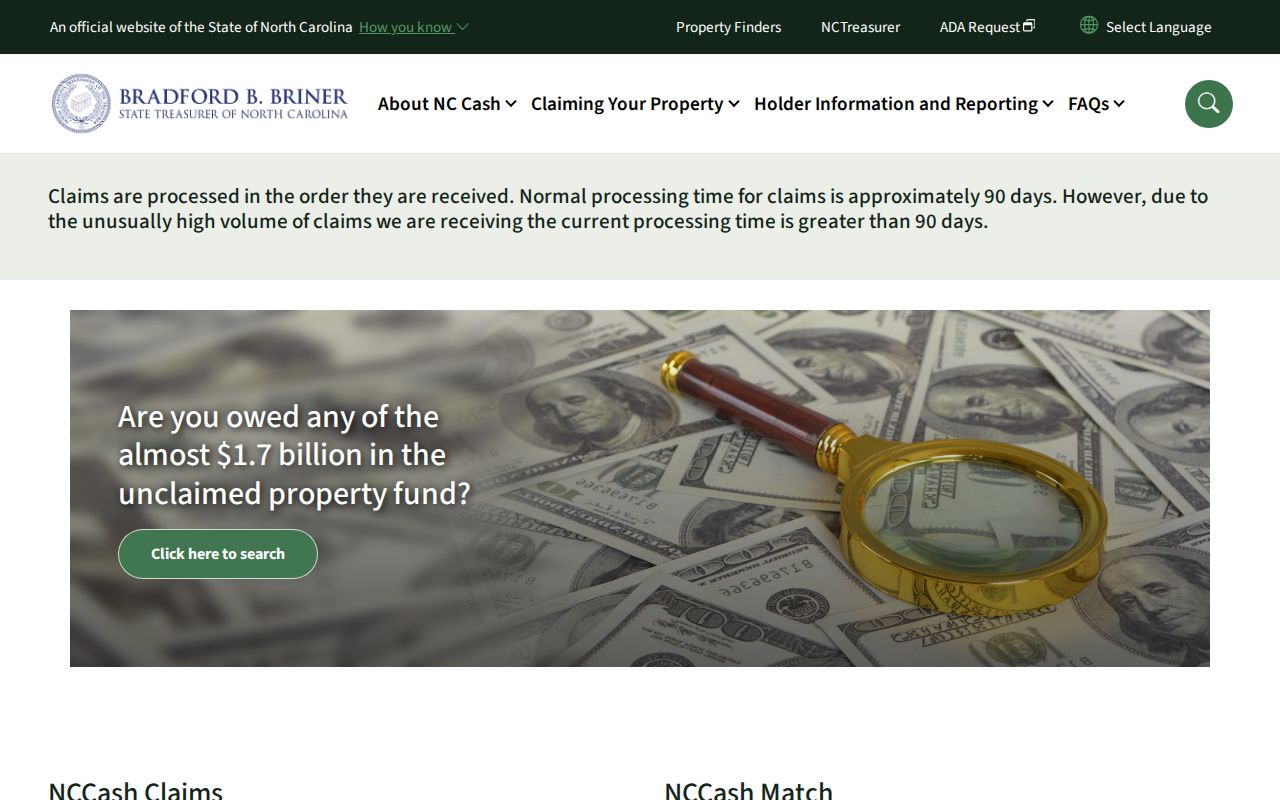
The captured state tool provides the direct verification route, avoiding fees charged by third parties that repackage the same public lead.
| Source type | Strength | Main limit |
|---|---|---|
| Official index | Direct custodian data and stable record ID | May omit images or protected fields |
| Certified copy | Custodian-issued legal product | Eligibility and statutory fees may apply |
| Commercial compilation | Can surface broad leads | May be stale, merged, or repackaged |
Trace Clayton Names Across Time
Johnston County’s surviving record trail reaches deep into the eighteenth century. Wills date from the 1746 or 1761 era, deeds from 1759, and marriages from 1760 or 1764, depending on the series. No official evidence supports a catastrophic courthouse-loss story. The better lesson is that online portals show only part of a much longer set preserved through the Heritage Center, State Archives, print indexes, and microfilm.
The Clayton Bud survives for 1883 to 1887 on a State Archives microfilm reel. Later newspaper, yearbook, census, deed, will, cemetery, and voter sources fill different periods. African-American family research has especially useful alternatives in the Heritage enslaved-person index, cohabitation and slave-marriage records, probate and deed files, and the Baldy Sanders Papers, which preserve enslaved births as early as 1774.
Clayton’s fast growth and annexation make time part of the search. A rural route, township reference, or old subdivision may not match today’s street or municipal limits. Preserve the date, name spelling, parcel ID, deed citation, and source type at each step.
Note: A yearbook proves an association for one year, a deed proves a transfer, and neither alone proves a household relationship.