
Which Clayton Records Are Open
Postal Clayton is not one records jurisdiction. The Town Clerk keeps municipal files, but Johnston County offices in Smithfield hold the main deed, tax, court, estate, and local vital-record systems. State agencies add voter, correctional, business, and statewide certificate sources. Start with the record type and keeper, then use the listed fallback if an online index does not supply the document itself.
| Record Set | Official Keeper | Online Route | Access and Fallback |
|---|---|---|---|
| Town meetings, permits, police reports | Clayton Town Clerk or department | Agendas, permit tools, NextRequest | Posted files or defined request; exempt details may be removed |
| Deeds, liens, plats, assumed names | Johnston Register of Deeds | EagleWeb land index and images | Free search; Smithfield counter for copies |
| Property and tax | Johnston Tax Administration and GIS | Property cards, tax bills, MapClick | Free portals; office request if needed |
| Civil, criminal, estate, wills | Johnston Clerk of Superior Court | eCourts for available case data | Courthouse terminal and clerk file |
| Birth, death, marriage, divorce | Register of Deeds, Clerk, NC Vital Records | County indexes or case captions | Eligibility, ID, form, and statutory fee apply to certified copies |
| Voter registration | Johnston Elections, NCSBE | Voter Search and weekly public files | Free access to public fields; protected identifiers withheld |
| Jail, correctional, offender registry | Johnston Sheriff, NC Adult Correction, SBI | Current jail list, state searches, registry | Sheriff phone or agency request; Clerk confirms disposition |
| Business and licenses | Secretary of State, Register of Deeds, boards | Entity, assumed-name, and board searches | Free portals or agency request; some statutory products cost money |
| Historical county files | Heritage Center and State Archives | Catalogs and selected indexes | Reading room, microfilm, copy, or research request |
A portal entry is often an index, not the full record. A court summary omits some pleadings. A vital index does not open the certificate image. A jail booking does not prove a conviction. Official copies come from the custodian, while older material may require the Heritage Center or State Archives.
Note: A Clayton mailing label can fall outside town limits or within the extraterritorial jurisdiction, so confirm the governing boundary before requesting permit files.
Clayton Records Under Chapter 132
North Carolina Public Records Law defines records by their connection to government business, not by whether they are paper, email, audio, or database rows. G.S. 132-6 permits any person to inspect open material at reasonable times and under reasonable supervision. The law calls for production as promptly as possible. It does not promise a fixed response period.
The ordinary copy charge under G.S. 132-6.2 cannot exceed actual cost, and routine staff time is excluded. A special charge can apply when a request demands extensive technology, clerical help, supervision, or an unusually costly medium. An agency need not create a report or answer questions, but a requester may seek an existing export in native format.
The official statute page shows the controlling chapter in context.
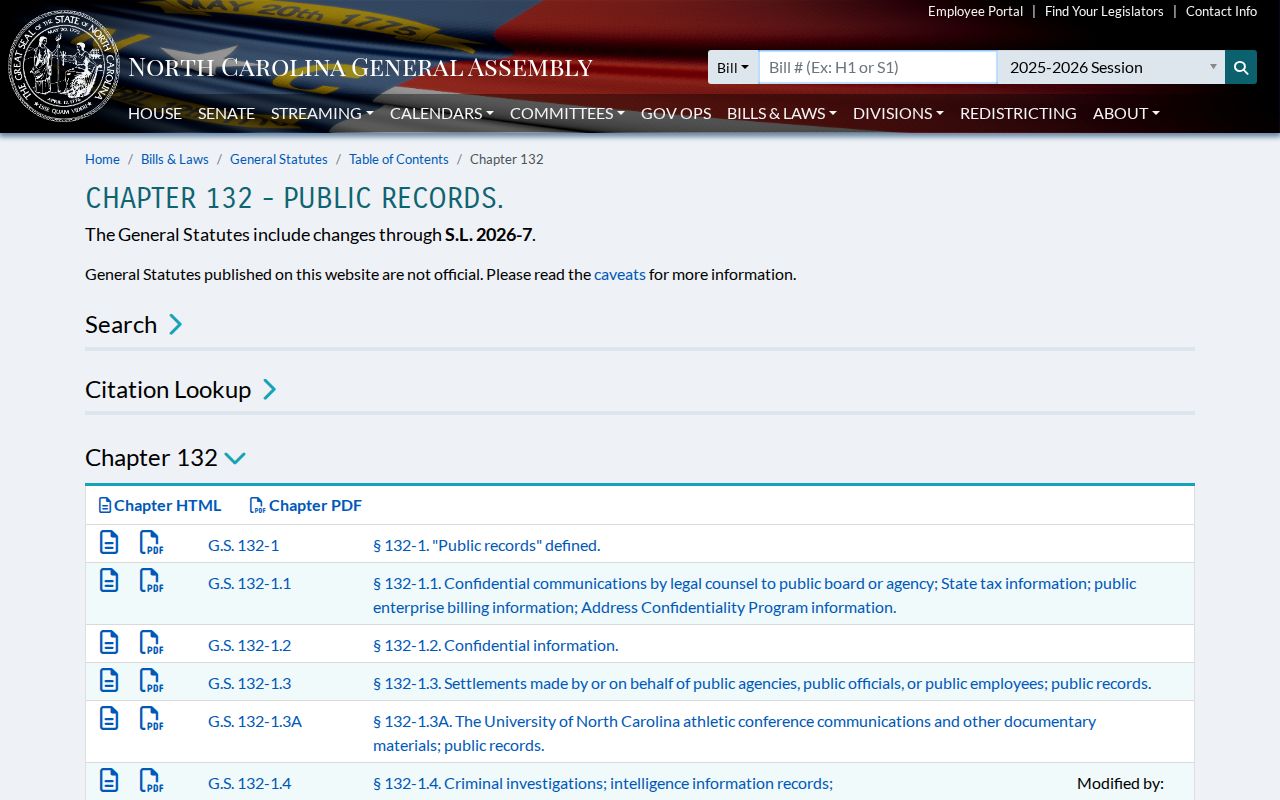
Use the chapter to distinguish general access rules from record-specific statutes that protect vital, voter, motor-vehicle, juvenile, and personnel information.
Clayton Deed Records in EagleWeb
The Johnston Register of Deeds public search offers land records with images and vital-record indexes without images. The entry gate requires acceptance of its disclaimer. Land images download as PDF files. The county is still adding older records back toward the county's beginning, so no exact first complete online year should be assumed. At the office, land-record staff can supply plain or certified copies.
The public search entrance makes the land-image and vital-index split visible.
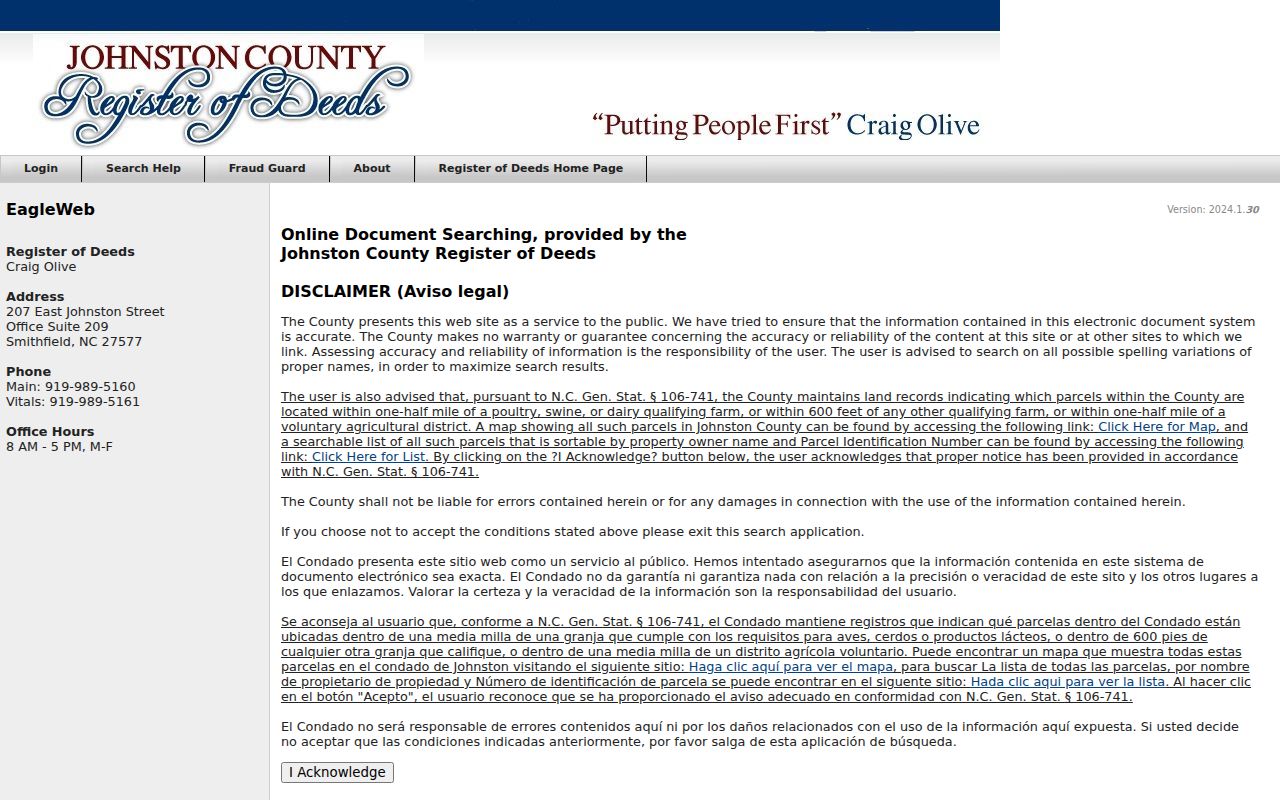
That split explains why a name may appear online while the related certificate still requires an authorized request.
| Search Control | Input | How It Works |
|---|---|---|
| Document Type | One or more types | Clear “Search All Types” before selecting specific types |
| Reception Number | Exact number | Direct instrument route |
| Grantor or Grantee | Name text | Search both sides of a transfer and spelling variants |
| Date Range | Start and end dates | Use the same date twice for one recording day |
| Subdivision, Block, Lot | Text or lot range | A colon creates a lot range, such as 12:30 |
| Basic or Advanced | Search syntax | * is a wildcard; + requires and - excludes a term |
- Grantor
- The person or entity transferring an interest.
- Grantee
- The person or entity receiving that interest.
- Index
- A searchable description that points to a record; it may not be the record image.
- Certified copy
- A custodian-authenticated copy, distinct from a plain download.
Clayton Property Record Boundaries
Johnston property tools separate three views. The property card shows the owner, mailing and physical or situs addresses, parcel identifiers, legal description, acreage, values, improvements, and deed references. “Situs” means the parcel's physical location. The tax bill focuses on the taxpayer, year, balance, and mailing data. MapClick adds parcel shape, nearby ownership, aerial context, and jurisdiction layers.
Do not treat a tax mailing address as the land's street address. The county warns that GIS or tax output may show where a bill goes. It can point to a nonresident owner, trust, agent, or stale mailing destination. MapClick is the better source for physical placement, while the recorded deed remains the ownership authority. Historic parcel downloads for 2002, 2010, 2018, and 2024 add useful snapshots when current cards no longer show a prior owner.
The access chain is property-card Basic Search, MapClick, downloadable current or historic parcels, then Tax Administration at 919-989-5130. Basic Search requires the user to choose owner name, parcel number, or property address. Current parcel geometry updates daily, while assessment attributes update monthly.
Clayton Court Records and Files
Clayton cases run through Johnston County District and Superior Courts. The free statewide eCourts Portal provides anonymous Smart Search, hearing, and judgment tools. A party-name query supports wildcard syntax, and filters can narrow by Johnston location, case type, status, or filing dates. Results may show case number, parties, filings, hearings, disposition, financial entries, and lawyers.
The portal is a discovery layer. Full pleadings, exhibits, audio, and certified dispositions come from the Johnston Clerk. Public courthouse terminals can search criminal records by defendant, case number, victim, or witness, along with civil, estate, and special-proceeding data. Older court series may require an archives request. The Clerk, not the Register of Deeds, also administers probate estates and wills filed for probate.
The Johnston County Courthouse page identifies the local office and services.
The courthouse route matters when an online docket omits the filing or when an official copy is required.
Clayton Vital Records Access
Johnston County's vital index does not make certificate images open. G.S. 130A-93 controls who may obtain certified copies, and the requester must provide the required identity and relationship details. The county application asks for the record type, event details, relevant family names, requester identity and relationship, delivery, and payment.
A Johnston certified birth, death, or marriage copy costs $10; an uncertified copy is $0.10. Mail carries a $1 minimum processing fee and needs a self-addressed stamped envelope. The local vital desk is at 207 E Johnston Street, Suite 209, Smithfield, 919-989-5161. North Carolina Vital Records is the statewide fallback and supplies state certificate products. Divorce files remain with the Clerk, while the state divorce certificate is only a summary.
The state ordering site shows the separate certificate request channel.
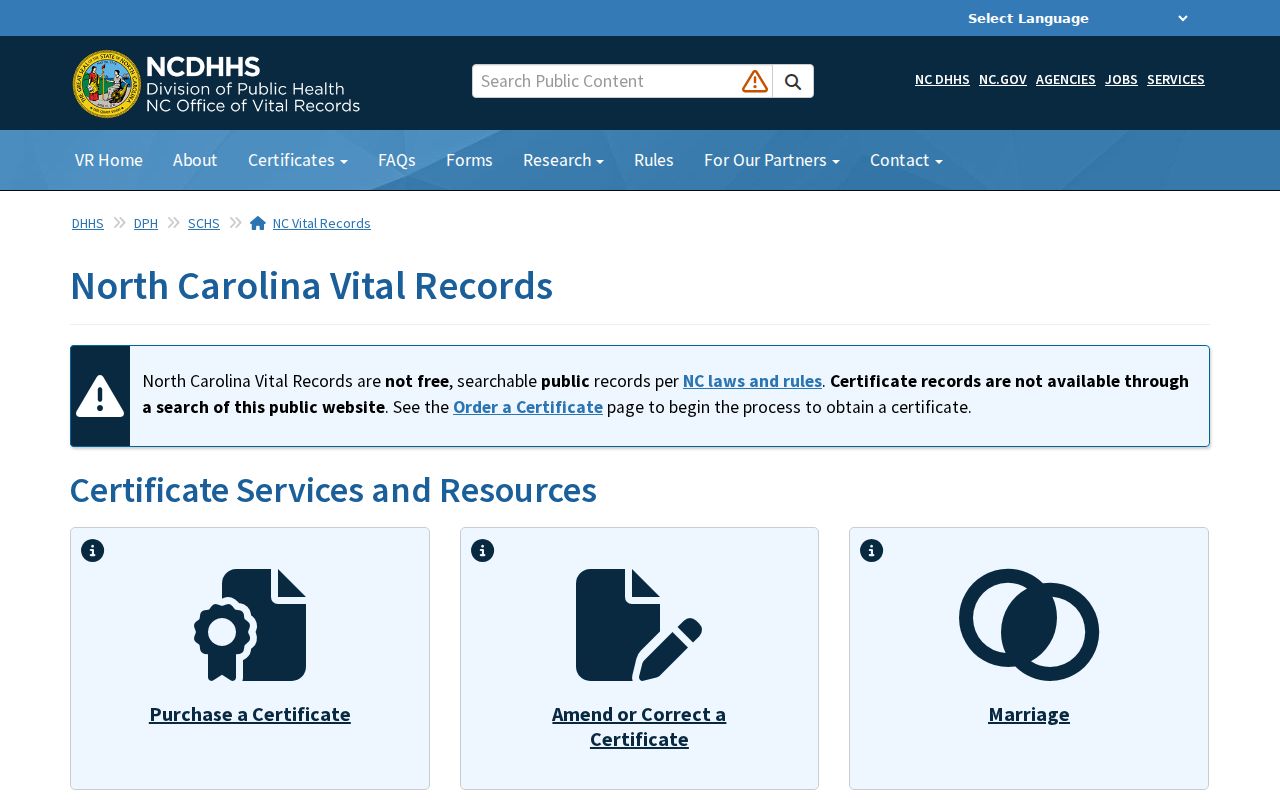
For older evidence, use Heritage Center marriage registers, bonds, newspapers, or archival collections, but do not treat them as certified legal copies.
Clayton Public Records Desks
The right desk depends on both the record and boundary. Town Hall handles Clayton municipal business. County land, court, and tax desks sit in Smithfield. Direct contact is the fallback when a portal fails, an image is absent, or a certified item is needed.
Johnston Register of Deeds
Smithfield, NC
County land-record custodian
919-989-5160
Johnston Clerk of Court
Smithfield, NC
County case-file custodian
District and Superior Courts
Call ahead when retrieval may involve an older file or offsite material. Use the courthouse page for current Clerk service details.
Request Clayton Public Records
For town material, search prior requests and released documents in NextRequest before opening a new matter. County and state files must go to their own custodians. A Town submission does not require Clayton staff to retrieve a deed, court file, tax card, or state record. Keep the scope tied to an existing file or data set.
- Confirm the boundary and identify the office that created or keeps the record.
- Search its public portal and save the case, parcel, instrument, permit, or request number.
- Describe the record, subject, date range, and preferred electronic or paper format. Avoid asking for “everything” about a person.
- Ask for ordinary copy costs and any proposed special service charge before work starts.
- If material is withheld, ask for the statutory basis and the segregable open portion. G.S. 132-9 provides civil enforcement.
The Clayton NextRequest form offers electronic delivery, pickup, in-person review, or mail, with charges possible for physical options.
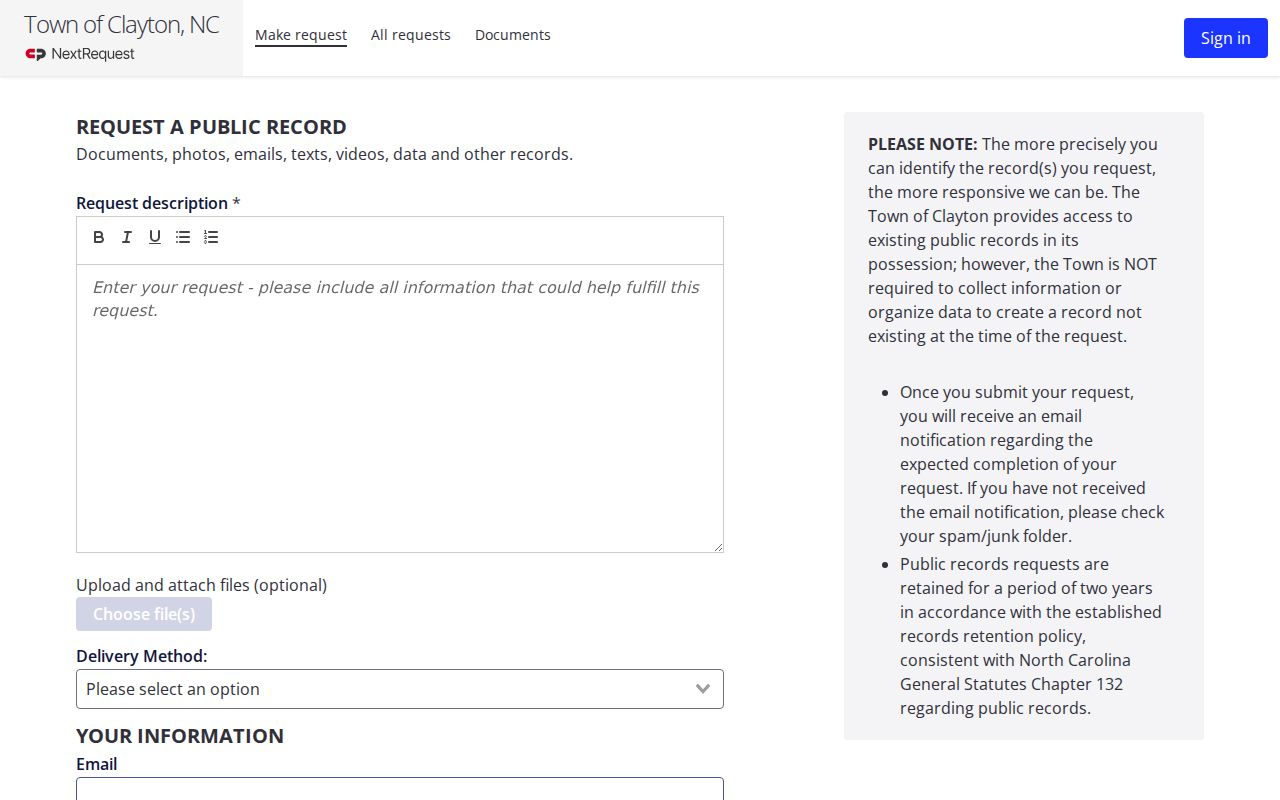
The delivery control helps a requester choose inspection when a copy is unnecessary or electronic files when that format is practical.
Lawful access. Open records support civic review, family history, estate research, and personal safety. Never use an address, court entry, registry result, or other public data to stalk, threaten, harass, or harm anyone.
Clayton Records Fees and Formats
Cost depends on the product, not just the subject. Town black-and-white copies through 11 by 17 inches cost $0.10 per sheet. A Register of Deeds plain copy is also $0.10 per page, with a $1 mail minimum, while an emailed plain document has no extra delivery charge. A certified recorded document costs $5 for the first page and $2 for each added page.
Recording fees are different from retrieval fees. An ordinary instrument costs $26 for the first 15 pages and $4 for each added page. A deed of trust costs $64 for pages 1 through 35, then $4 per page. Plats cost $21 per page. These charges matter to a person filing a document, but they should not be confused with the fee for an existing copy.
State Vital Records charges $24 for a three-year search or portion and one certificate, even when no match is found. The Heritage Center charges $5 for an obituary article copy and $40 per hour, with a $40 minimum, for staff research. Free online access still has limits: an index can point to a record while certification, staff research, or a statutory product costs money.
Note: Ask whether a plain electronic copy will meet the need before ordering certification or staff research.
Clayton Records That Stay Closed
Chapter 132 is broad, but specific laws control many sensitive fields. Juvenile, adoption, sealed, and expunged court matters are not ordinary open dockets. Public court files may still redact Social Security numbers, financial accounts, victim locations, medical material, and protected domestic information. Most municipal personnel-file content is closed beyond the fields made public by G.S. 160A-168.
Certified vital copies require statutory eligibility. Voter records disclose a defined public core, but exact birth dates, Social Security information, driver-license numbers, registration-agency identity, election email, and voter identification materials remain confidential. Protected addresses can be withheld through the North Carolina Address Confidentiality Program. Motor-vehicle personal data also follow the federal DPPA and G.S. 20-43.1, not the general records presumption.
An old record is not automatically open online. G.S. 132-11 creates a general 100-year confidentiality sunset but preserves listed federal, sealed, juvenile, security, and identifier exceptions.
Clayton Records Across Three Centuries
Johnston County formed in 1746, long before Clayton's 1869 charter. Local trails reach wills from the 1746 or 1761 era, deeds from 1759, and marriages from 1760 or 1764. No verified catastrophic courthouse fire explains a broad gap. Old Clayton-area names may remain traceable through county files rather than a later town ledger.
The Heritage Center extends past the web. Its deed microfilm covers 1759 through 1947, marriage registers 1760 through 1979, and wills 1761 through 1968. The obituary index begins in 1801. Created in 1997, the center opened in 2000 and made indexing and digitization part of the county's modern access system.
| Period | Clayton Area Records Route |
|---|---|
| 1746 to 1868 | County deeds, wills, marriages, estates, and predecessor-area materials |
| 1869 onward | Town records join the existing Johnston County systems |
| 1997 to 2000 | Heritage Center created and opened in its Smithfield home |
| Current | Portals aid discovery; counters, microfilm, and archives remain essential fallbacks |
Clayton Deed Alerts Through FraudGuard
Johnston County has offered free FraudGuard alerts since 2013 and renewed its warning in 2024 after a nearby fraudulent deed. A subscriber enters a personal or business name and receives email when that name appears on a newly recorded instrument. The service is useful for early notice, especially when a property owner does not visit the deed index often.
The Johnston FraudGuard notice explains both the alert and its limit.
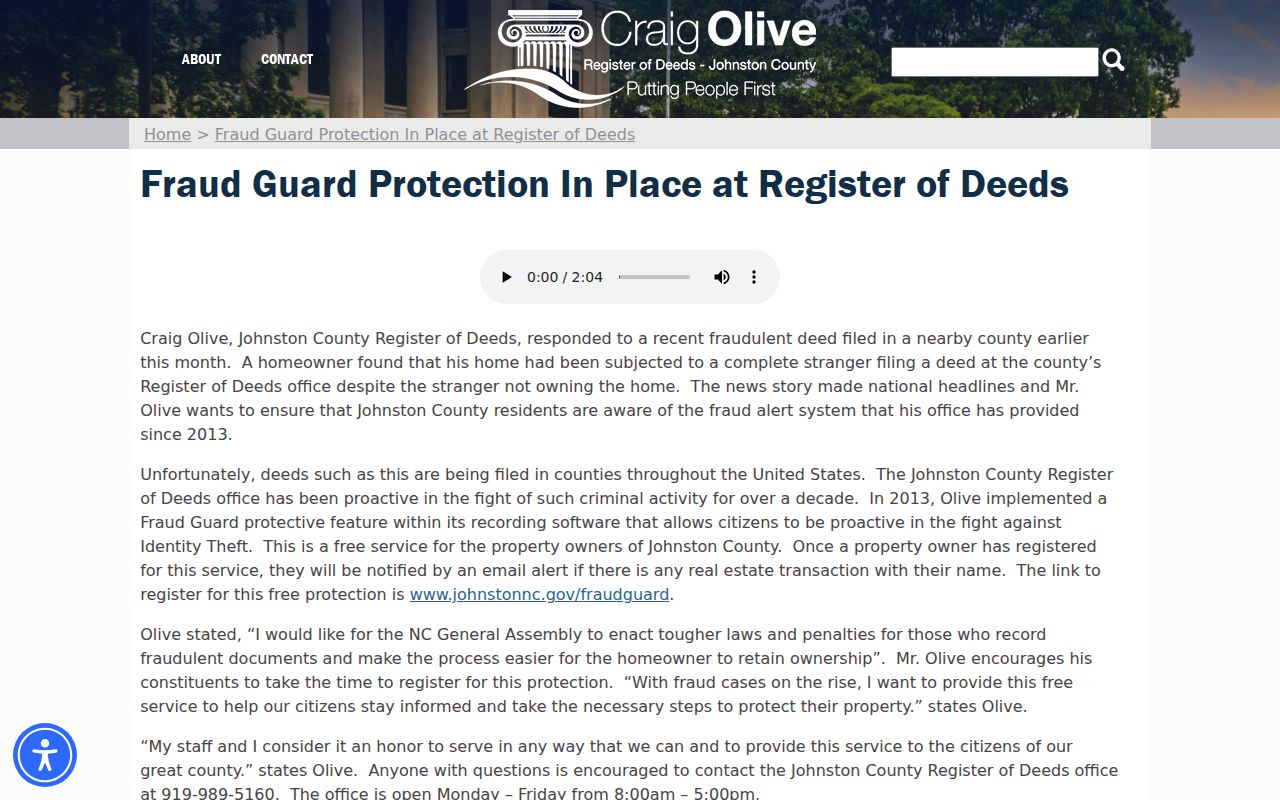
An alert arrives only after an instrument records. It does not block, validate, or cancel the filing. Compare the notice with the deed image, then contact the Register of Deeds and law enforcement if the instrument appears false. Ignore private mail that sells urgent “protection” or an overpriced deed copy when the official index and low-cost custodian copies are available.